

Lessons from 450 sq. ft.
What I learned about maximizing space, style, and sanity in my tiny bungalow

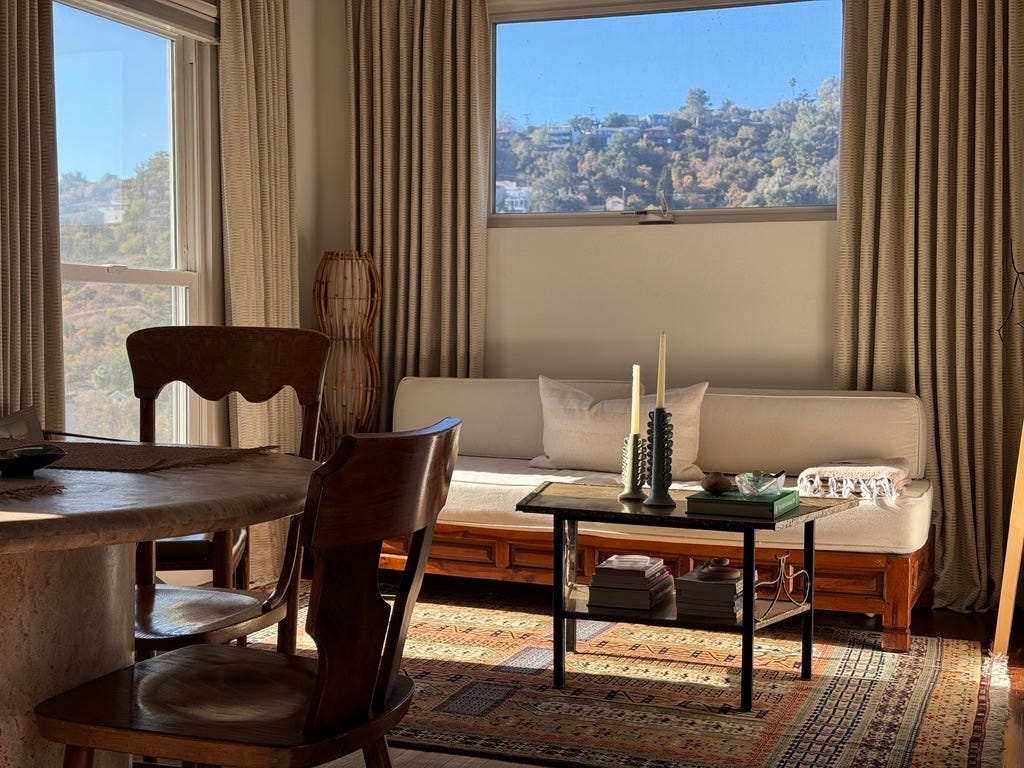
As I pulled out of LA earlier this month, my car jam packed with belongings despite already having filled an entire moving truck, I thought, “how on earth did I fit all of this stuff in my tiny studio apartment?” It was my eighth apartment in 14 years, the smallest space I ever lived in, with virtually zero storage and barely room for a sofa (certainly not a full-sized one). But it was also my favorite, the one I called home the longest, and the first that I actually put true energy into decorating. I spent the last five years cycling things in and out, fine tuning every shelf and corner. The result was a car full of cherished belongings I actually wanted to take with me, not just throwaway things to fill the space.
Living in a 450 square foot apartment has been an exercise in intentionality. The hundred-year-old bungalow featured a built-in pass-through shelf separating the bedroom, and large glass doors opening out onto a lush private patio, giving the illusion of space beyond the walls. The light streamed in beautifully, the design was airy and thoughtful, but let's be real: 450 square feet is 450 square feet, no matter how dreamy I made it look on the internet.
With a tight footprint, entirely open shelving, and exactly one small closet to work with, I had to get very creative about storage and flow. I love to cook and host, I work from home full-time, I need a setup for my jewelry design, and I refuse to live surrounded by visual chaos. So I spent the past few years figuring out how to make the space work for me. My takeaways ultimately had little to do with buying more bins or becoming a minimalist, but rather how to live in harmony with the things that filled it.
Invest in Meaningful Belongings
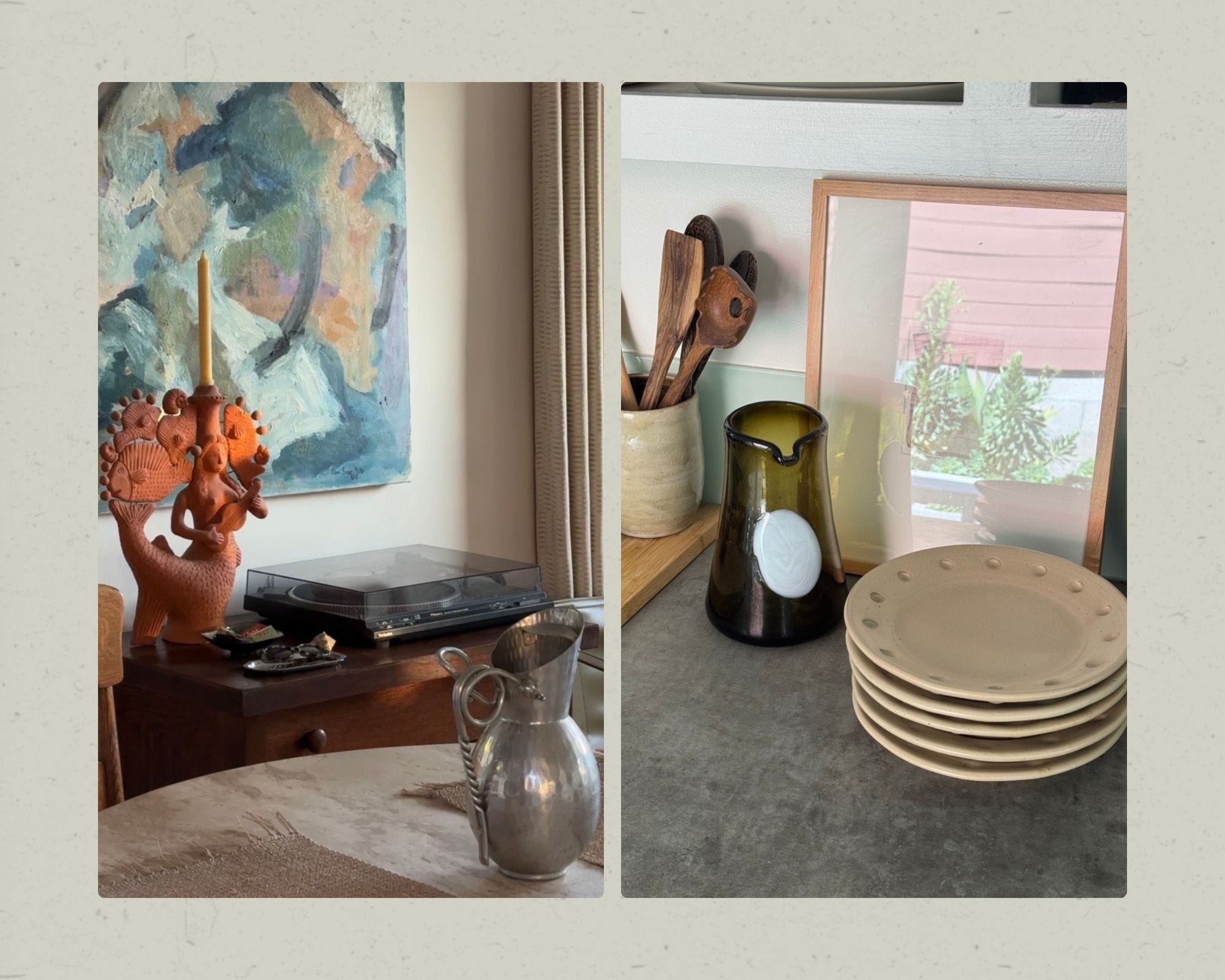
I’m not going to unilaterally tell you to “have less stuff.” I love stuff, I’m a collector (or at least that’s how I justify it). However, I do think it’s important to practice discernment when it comes to what you bring in, and think critically about what’s “worthy” of taking up space in your home. “Worthy” will mean different things to each of us, especially for decorative pieces that aren’t assigned the same inherent value as a functional object, but some helpful parameters: Is it made from a quality material? If you returned home after a year away, would you notice if it was missing? What feeling(s) does it evoke? I found garage sales and flea markets useful for quickly filling my shelves with vintage objects, and then gradually swapped things out for more personal souvenirs and handmade pieces from friends.
Experiment with Layouts
Growing up, rearranging my bedroom was one of my favorite pastimes. The thrill of moving the final piece into place, slipping into the hallway, and reentering with a fresh view was unmatched. Good news, it’s still possible to achieve this same feeling as an adult. Try different arrangements with what you already own— I’ve moved my furniture, rugs, art, and lamps around in countless configurations, and each taught me something new about my preferences and how I actually used the space.
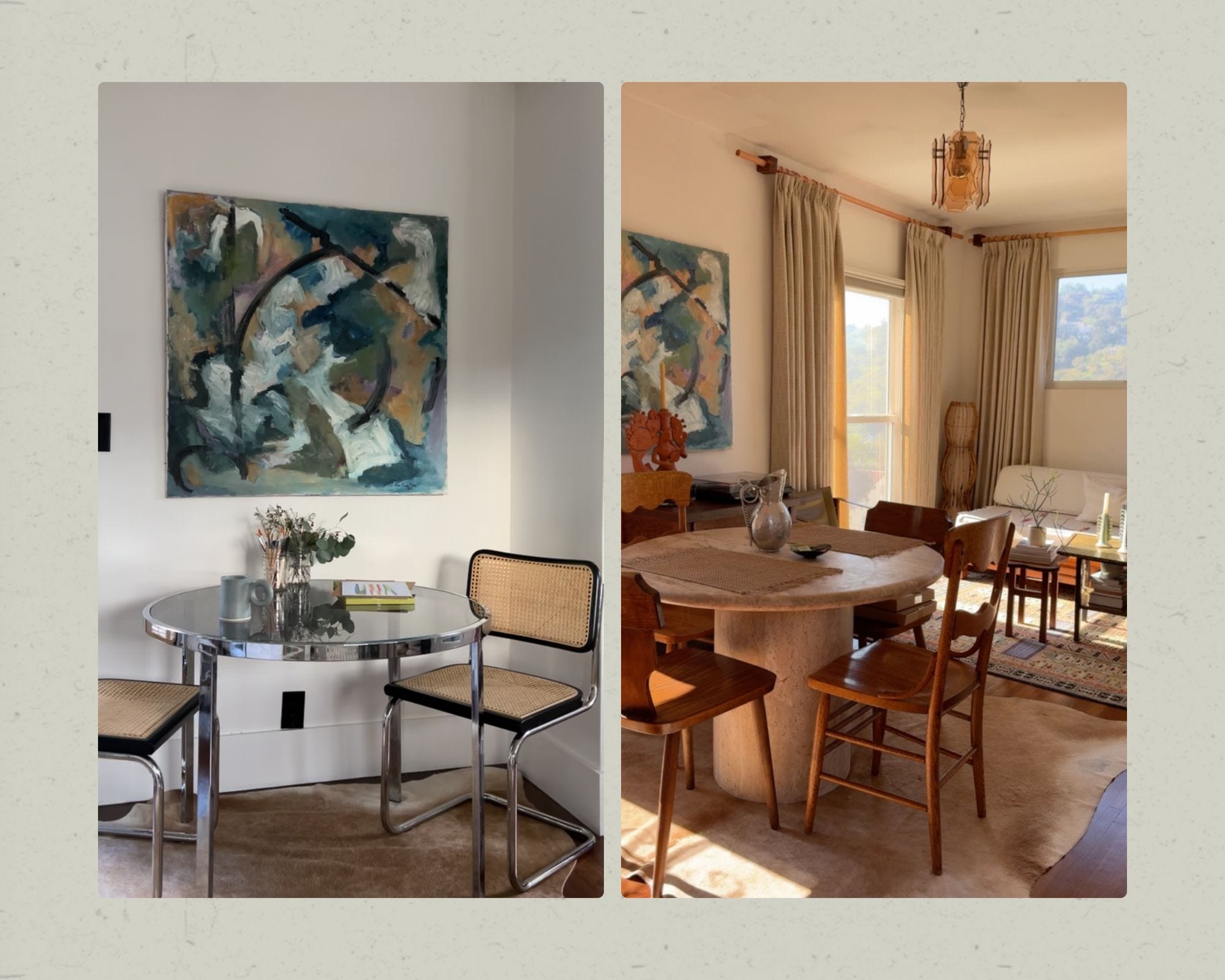
The biggest unlock came from a call with interior designer Natalie Myers who helped me realize that, despite living in a small apartment, I had more options than I realized. She helped me let go of the belief that everything had to be pushed up against a wall, and suggested moving my dining table to the center of the room. Suddenly there was room for four people to sit comfortably, and the room felt considered rather than an awkward puzzle.
Take Up Space
This one is a bit counterintuitive. In a small apartment, my first instinct was to attempt to visually shrink my furniture by choosing “invisible” pieces—glass coffee and dining tables, low profile cantilever chairs—thinking it would make the room feel bigger and less cluttered. While that logic might make sense on paper, in practice, the result felt noncommittal, with a lot of floating legs. A room needs visual anchors, and if you’ve decided a piece of furniture is worth giving up precious square footage, own it. The same goes for light fixtures, curtains, decorative objects, pretty much anything taking up real estate in your small space. A collection of many small ceramics and tchotchkes can quickly feel too busy and cluttered, but a carefully selected larger scale vase feels like a statement.
I traded my Milo Baughman glass dining table for a substantial Postmodern travertine, and the room instantly felt grounded and intentional. Similarly, replacing the small Akari pendant with an oversized version helped create more of a moment and further define the bedroom as it’s own zone.
Think of Furniture as Decor
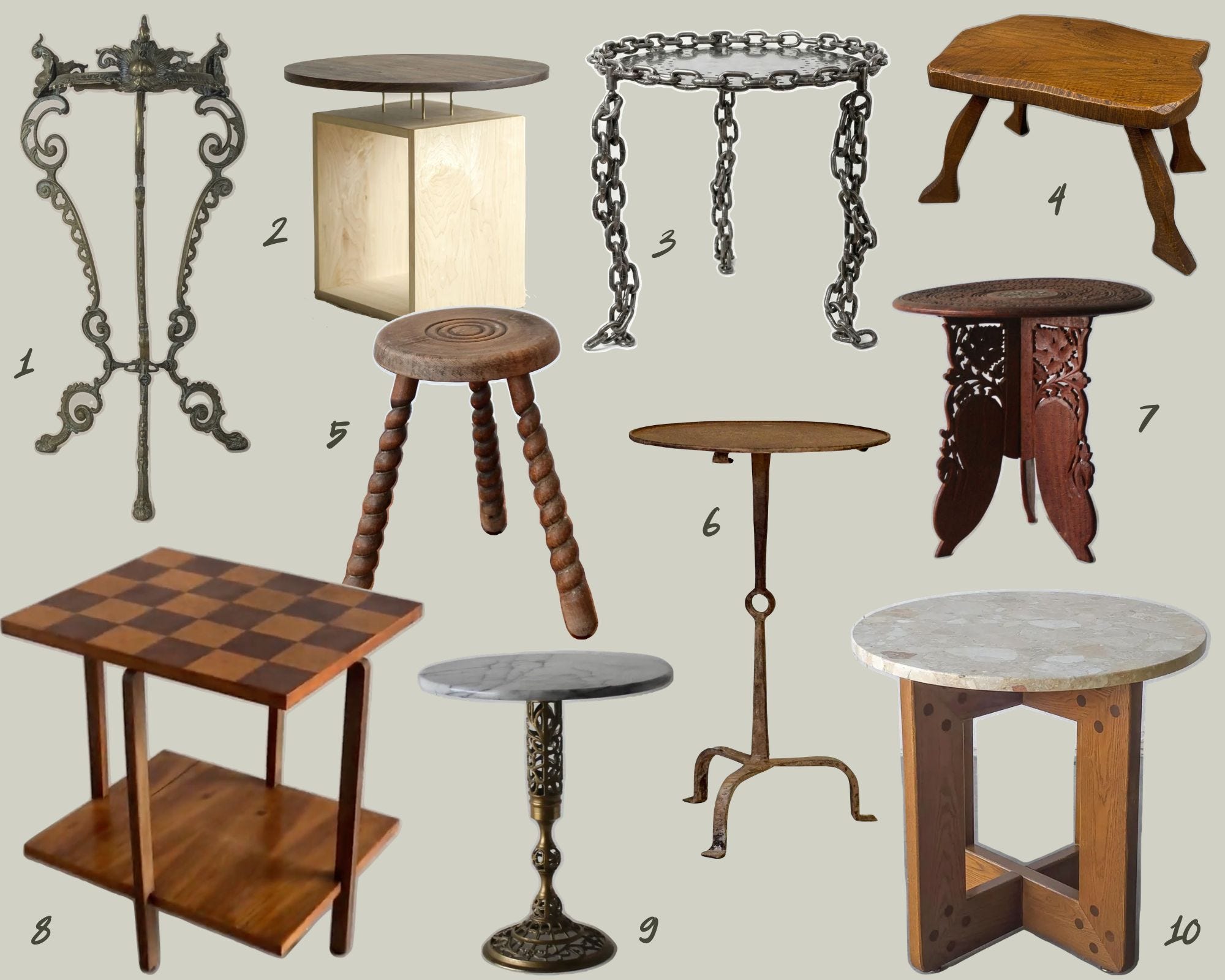
When you can only fit a few pieces, each one becomes infinitely more important. Because I don’t have much room for decorative objects, I rely heavily on my functional items to do the heavy lifting when it comes to creating visual interest and personality.
Play with scale and look for pieces with interesting details, beautiful materials, or unique shapes. Vintage items are an excellent shortcut here, as most check at least one of those boxes. A simple wooden stool can become sculptural, and a statement lamp can add just as much interest as an art object.
Shop Outside the Box
Aside from some initial broad narrowing, I rarely use category filters when shopping online. While hunting for my dining table, I realized that some of the most beautiful small round stone tables are actually classified as “entry” or “accent” tables. Similarly, my sofa is technically a daybed, which gave me the perfect proportions. Ottomans can be coffee tables, and end tables, nightstands, and stools can all be interchangeable depending on your needs.
Make Your Systems Work for You
All the bins and specialty organizers in the world won’t help if you don’t have a system in place that works for you. Although it was clear that my underbed storage was valuable square footage, I hardly utilized it. I had plenty of storage containers, but they were hard to access and I had no idea what was in them. I eventually (albeit somewhat reluctantly) invested in a hydraulic storage bed from Sundays Furniture, created labels for all of my containers, and, just like that, the friction was gone.
I’ve found that it’s much easier to introduce solutions than it is to change habits. Instead of shaming myself for all of the misc. items accumulating on my counter after each emptying of the purse and pockets, I put a large bowl there to keep it all contained. Realizing that I never put my shoes back properly in the closet, I worked to remove the barrier (in this case, the fact that the rack was hard to reach) by rearranging the layout. Sure, I could have kept telling myself to put things back where they belong, but after years of actively not doing it, I decided to make it easier on myself. Notice your patterns— where there’s friction, where things tend to accumulate, and think about what you could introduce to help bring some order to those places.
Give Your Decor a Job
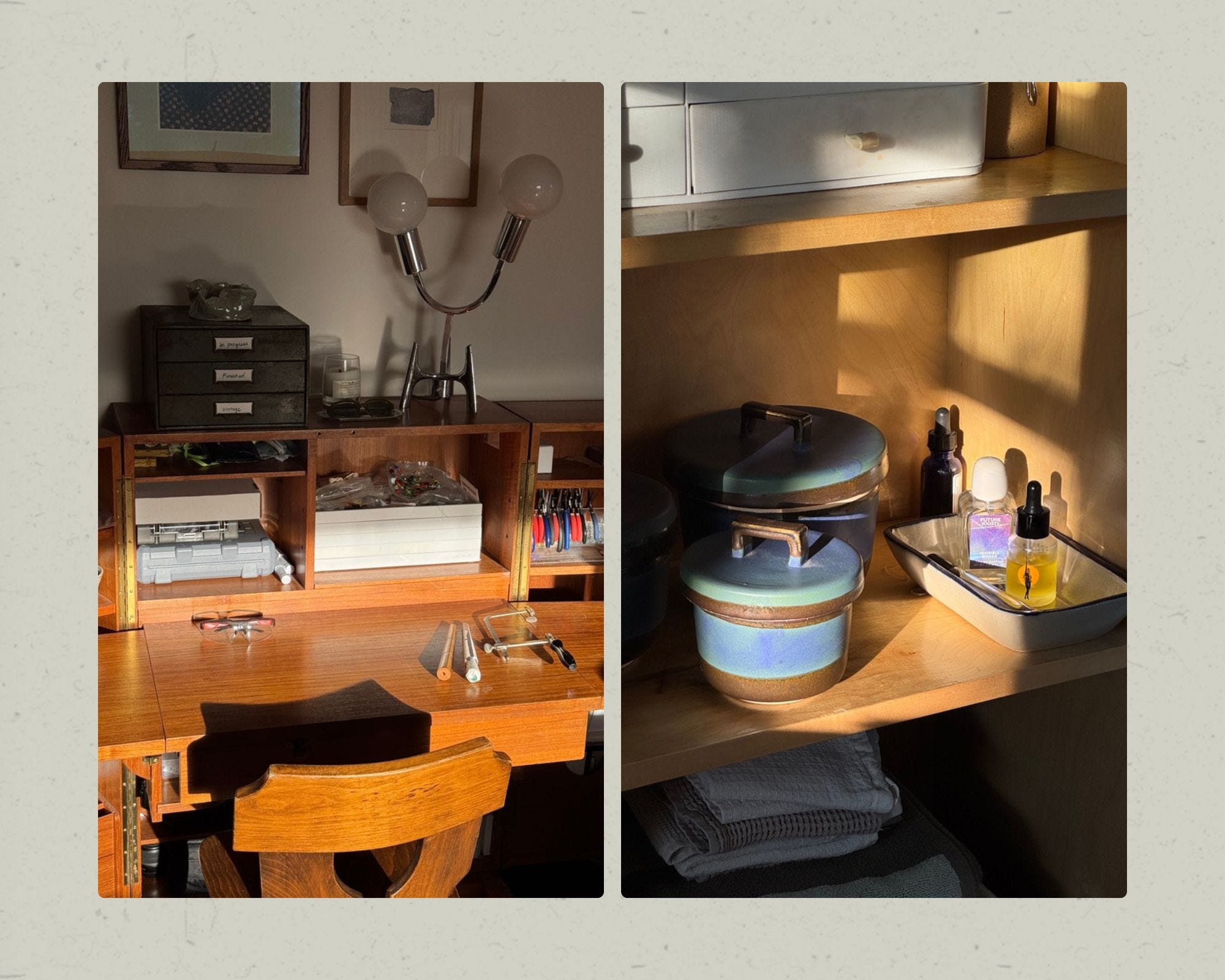
If you’re short on space, evaluate missed opportunities, big and small. My favorite storage and organization “solutions” are mostly just vintage objects I’ve repurposed (I wrote a whole post about it here). Carved wooden boxes, lidded ceramic vessels—each piece of decor can double as an opportunity to stash remotes, sunglasses, chargers, and so much more.
Trade leggy nightstands for ones with drawers, consider side tables that can double as laptop stands or TV trays (I love this steel option). As I’m writing this from my friend’s apartment, I’m reminded of the ultimate workhorse: the Aalto stool (and its many dupes). Hers serve double triple duty as side tables, footrests, and extra seating for guests.
I design and make jewelry, but had always struggled to carve out a workstation in my previous apartments. After discovering “magic box desks,” ingenious mid-century teak workstations that fold up into compact cabinets, I tracked down my own on Facebook Marketplace. The unassuming piece has a small footprint, yet comfortably stows all of my supplies and unfurls into a full desk in seconds, providing a workbench I never imagined possible in a small space.
Use Rugs to Define Your Zones
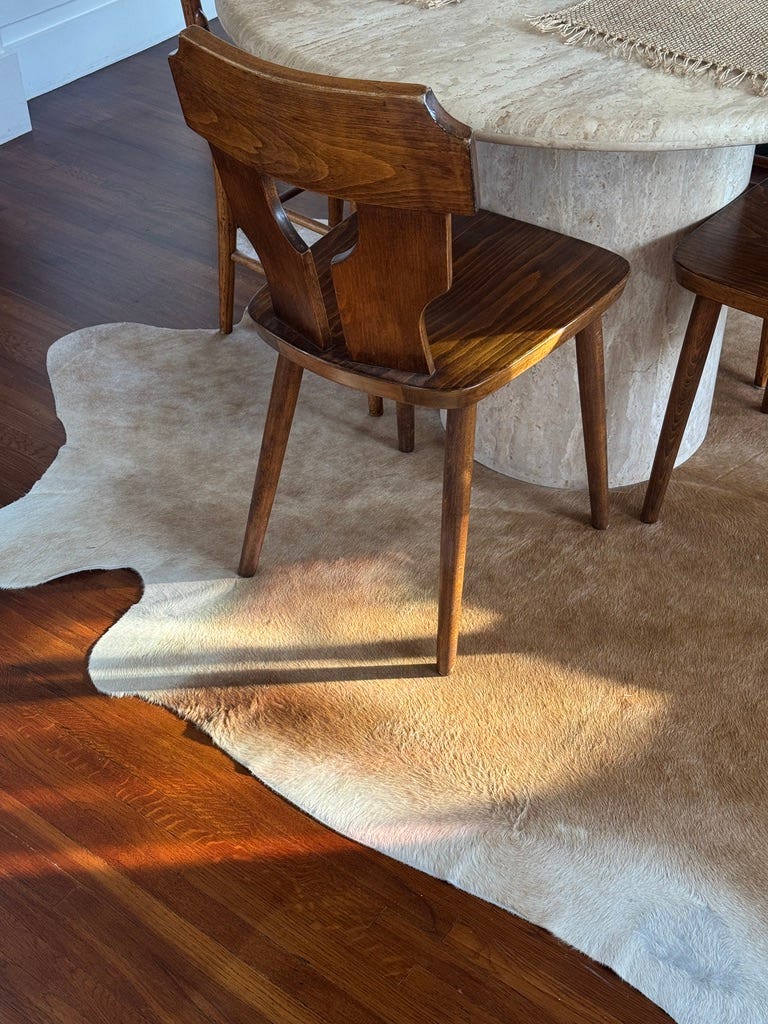
In a studio apartment, rugs are everything. They're the easiest way to create distinct areas within one continuous space. I used a large rug to define my living area, a smaller one a few feet over to designate the dining area, and, just beyond that, a runner for the kitchen. I’ve found that irregularly shaped cowhides are great for smaller areas, and create a nice contrast to keep everything from feeling too boxy.
Note: make sure your rugs are big enough to actually anchor the furniture. A tiny rug floating in the middle of a seating area just emphasizes how small and cramped everything is. But a properly sized rug that fits under all the furniture legs creates a real sense of place and makes each zone feel intentional.
Don't Be Afraid of Color
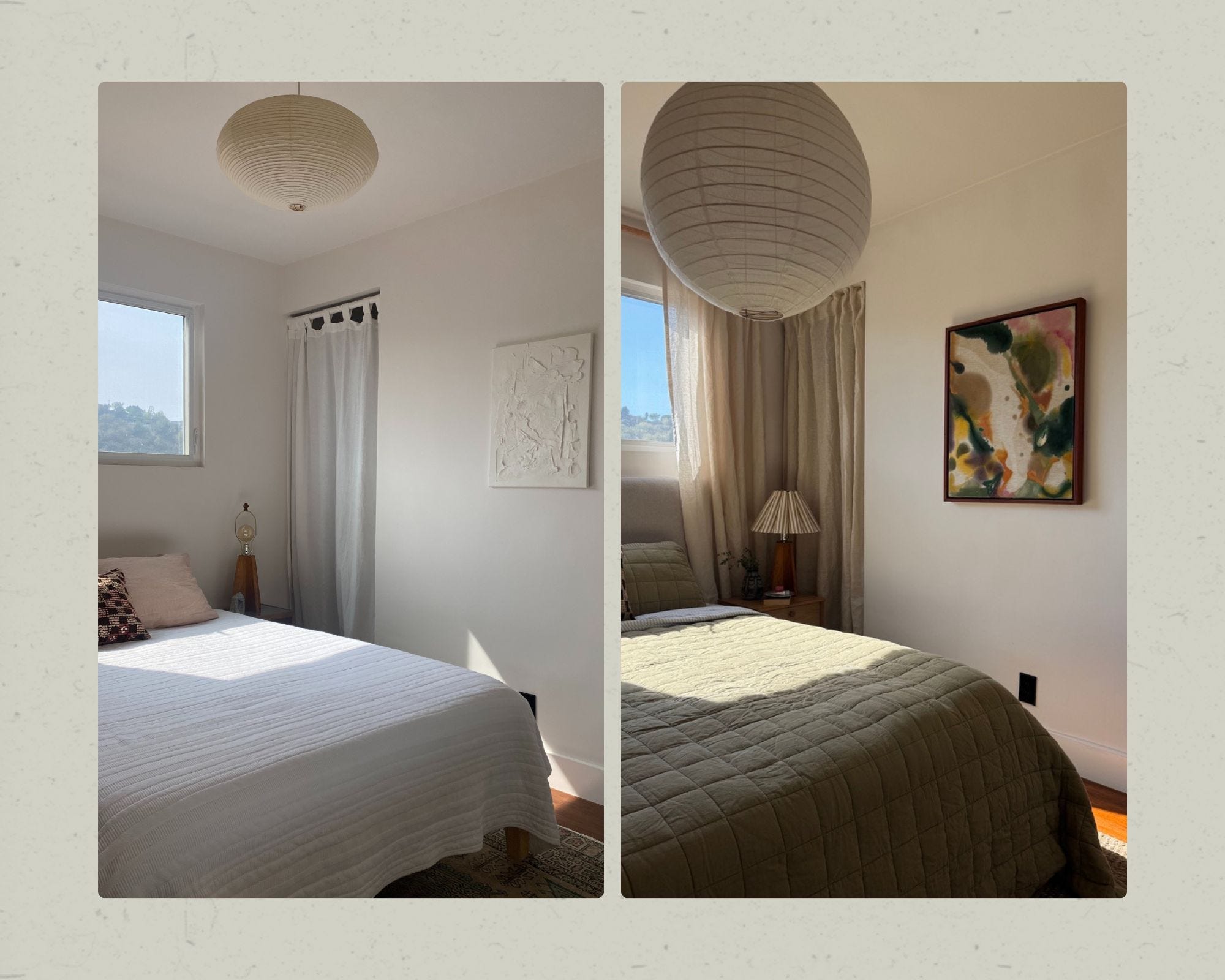
When I first moved in, I was intimidated by the open sight lines of a studio and convinced myself I had to keep everything neutral and "minimal" so it would all match and feel cohesive. I fell in love with a colorful painting from the flea market and slowly began using it as the palette to introduce more color throughout the bungalow. The color ended up making the small space feel more interesting and complex, not more crowded. Each area had its own personality, but everything still flowed together because I remained thoughtful about the overall color story.
Live in It Before You Solve Everything
This might be the most important advice I can give: don't feel like you need to have everything figured out immediately. I lived with pretty sparse decor for longer than I care to admit, slowly adding pieces as I figured out what worked for me. Give yourself time to understand your patterns. How do you move through the space? Where do you naturally want to set things down? What areas get used constantly versus barely at all? Living in it for a bit will save you from the string of quick-fix “solutions” that end up on the curb, and help you invest in pieces that actually improve your daily life. When you get it right, a small space can feel more luxurious and carefully curated than a sprawling house filled with random stuff.
What small space lessons have you learned? Share with the class!
xx Lindsay
You Don't Need Another Plastic Organizer [2026 Redux]
![You Don't Need Another Plastic Organizer [2026 Redux]](https://substackcdn.com/image/fetch/$s_!dcEo!,w_280,h_280,c_fill,f_webp,q_auto:good,fl_progressive:steep,g_auto/https%3A%2F%2Fsubstack-post-media.s3.amazonaws.com%2Fpublic%2Fimages%2F9035adf1-5f9a-4e93-bba9-1471f31bd50c_4000x2250.jpeg)
This was one of my most popular posts of 2025, so I'm bringing it back with all new, freshly sourced finds for the new year.
Your newsletter is definitely the best curation in my inbox!!
Please come over and help me!